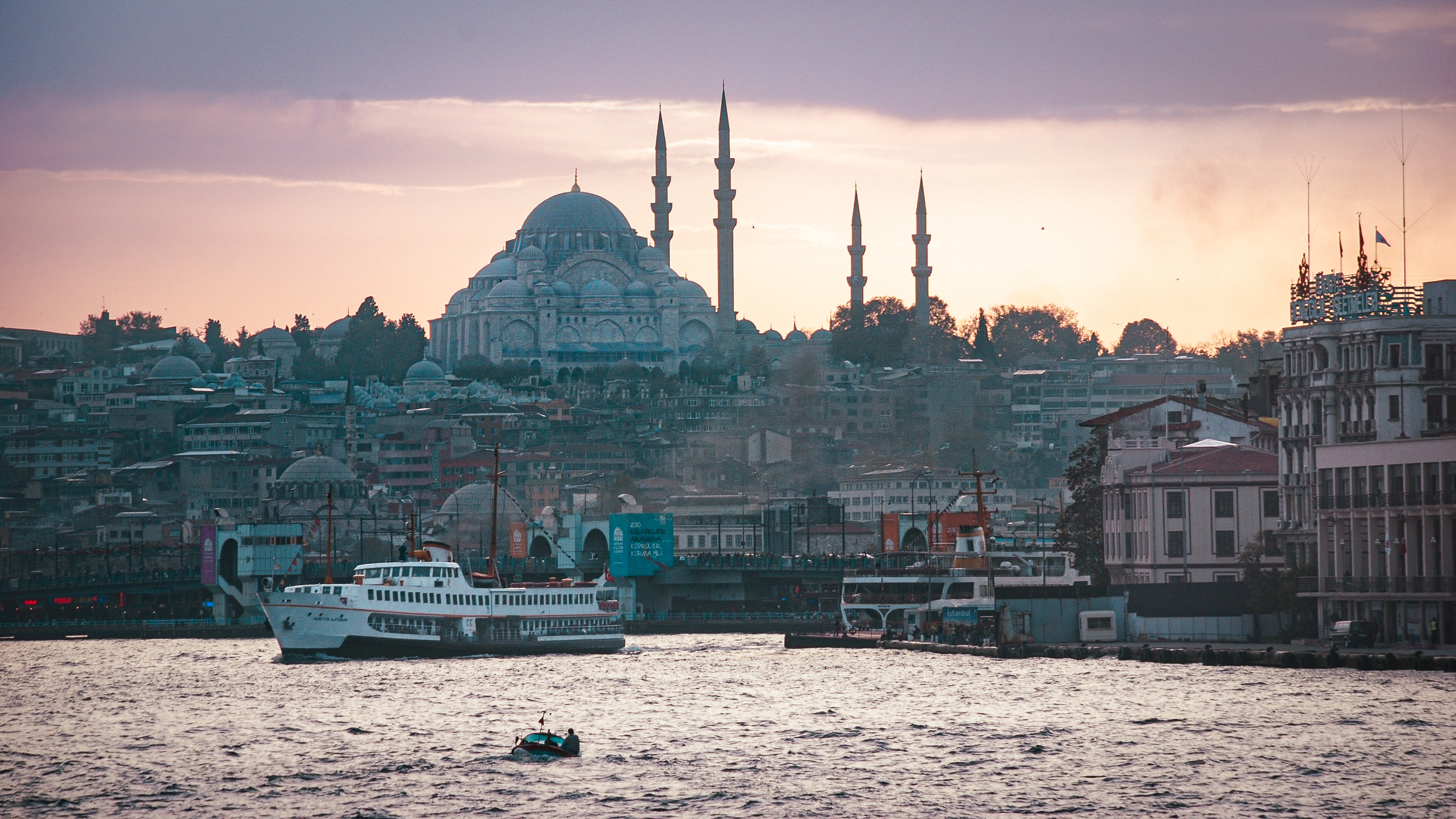
During my visit to Istanbul, I hired a driver. He took me from the ancient city and its Golden Horn all the way to the mouth of the Black Sea.
At the scheduled time, I stood on the cobblestone street in front of the guesthouse that was my home in the Sultanahmet district. Soon, a shiny black four-door sedan pulled up. The driver wore a crisp white shirt, black trousers, and a black coat. He walked around the car to the rear passenger door and opened it for me. The car’s interior was dressed in an immaculate white leather. He was Russian and spoke very little English. I spoke no Russian.
For the rest of the day, despite the language and cultural, barriers, we got along great. He was a wonderful host and guide. My camera was in my hands like a permanent appendage. I believe he saw this as a clue. He never missed an opportunity to stop whenever light fell just right on an old mansion, mosque, or fishing vessel.
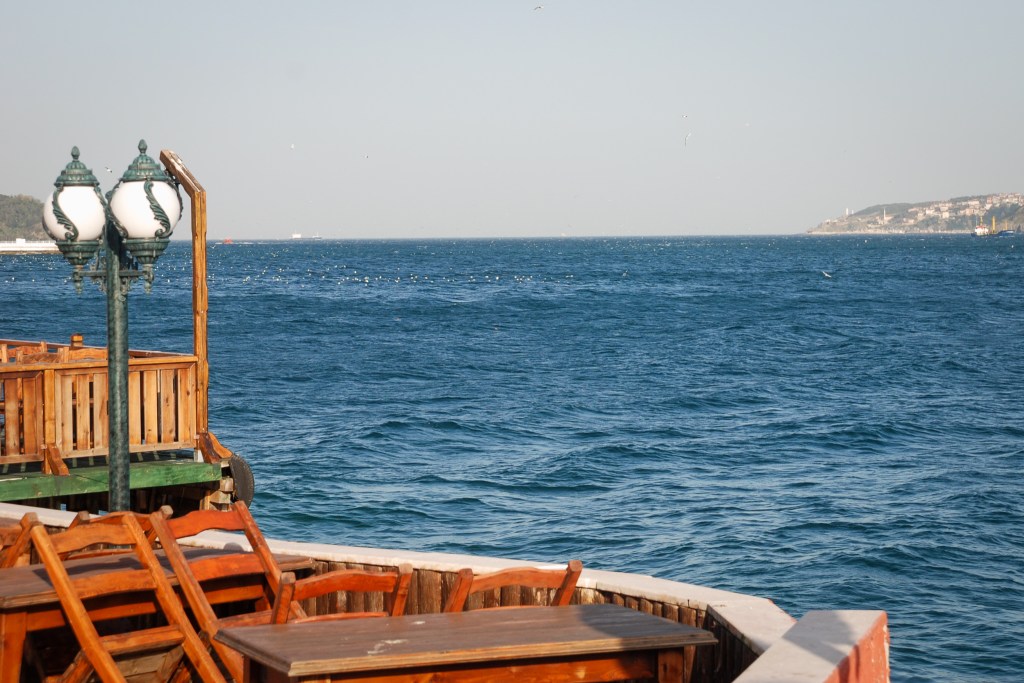
At the apex of our trip, we reached the point where the Bosphorus meets the Black Sea. My driver took me to his favorite seafood restaurant. He ordered for both of us – fresh sardines straight from the Black Sea over mixed greens. A meal and a trip I will never forget.
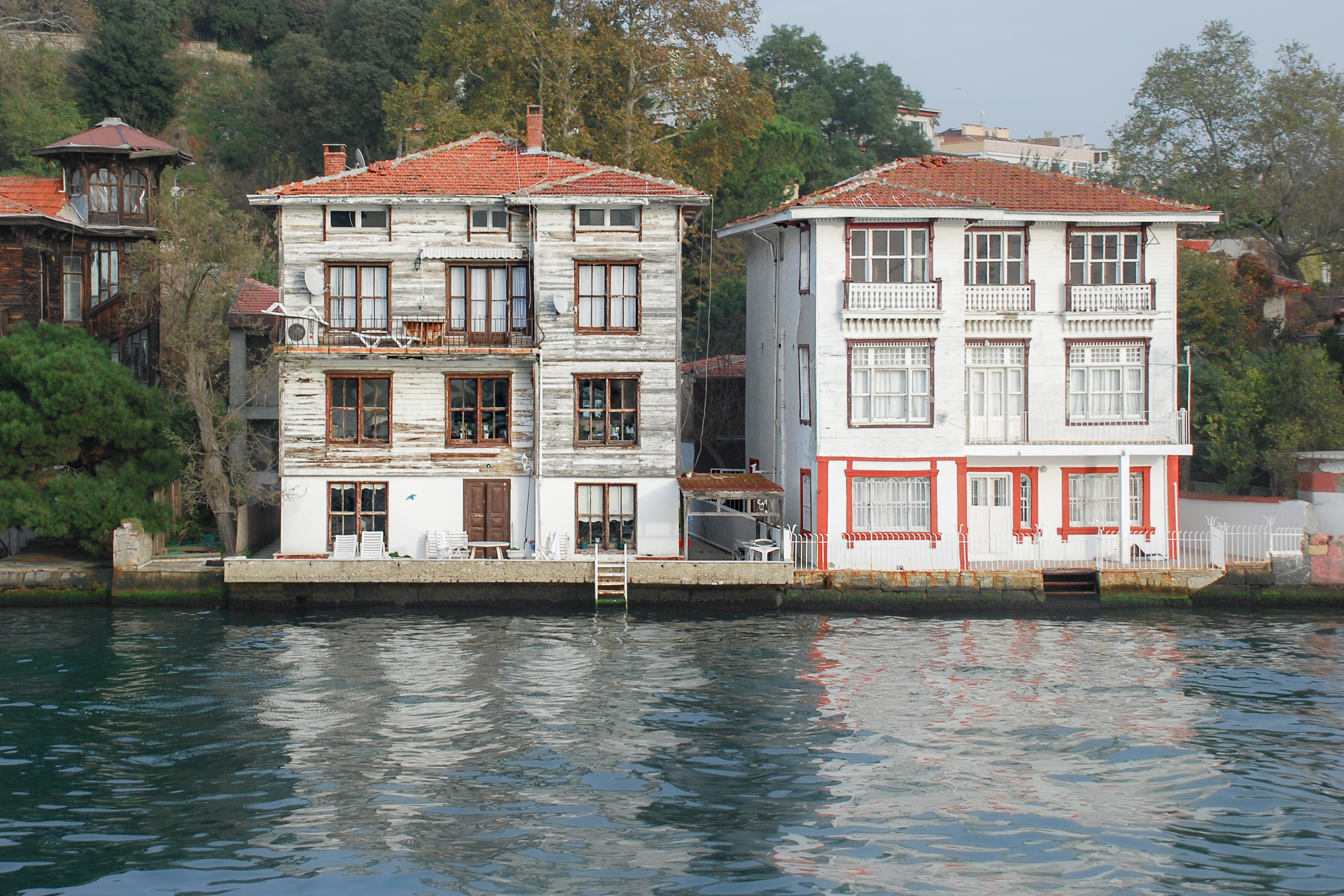
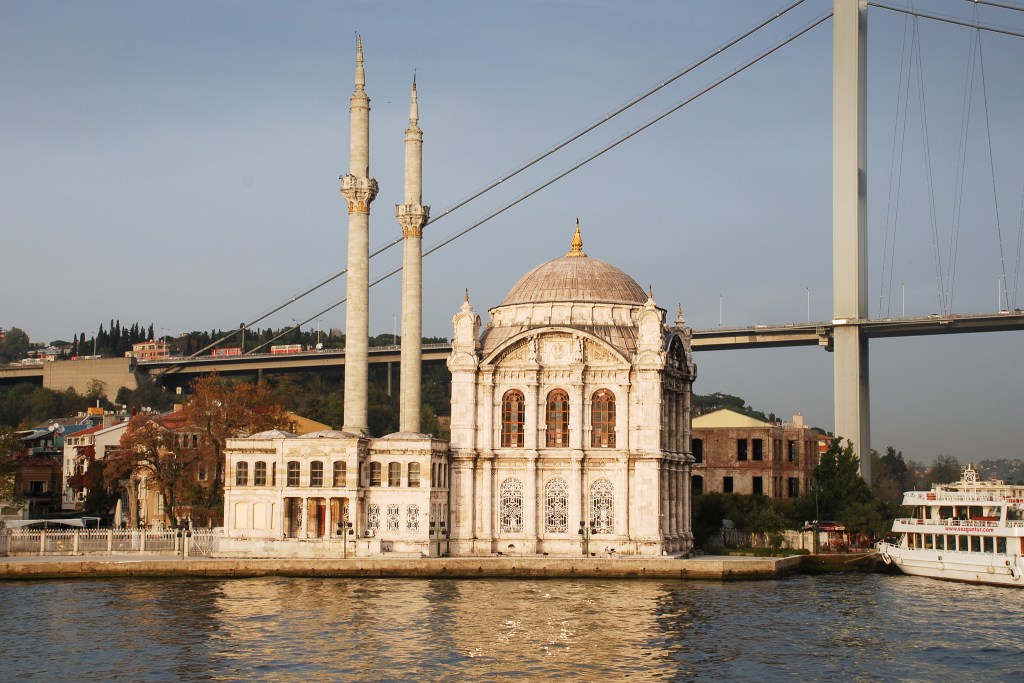
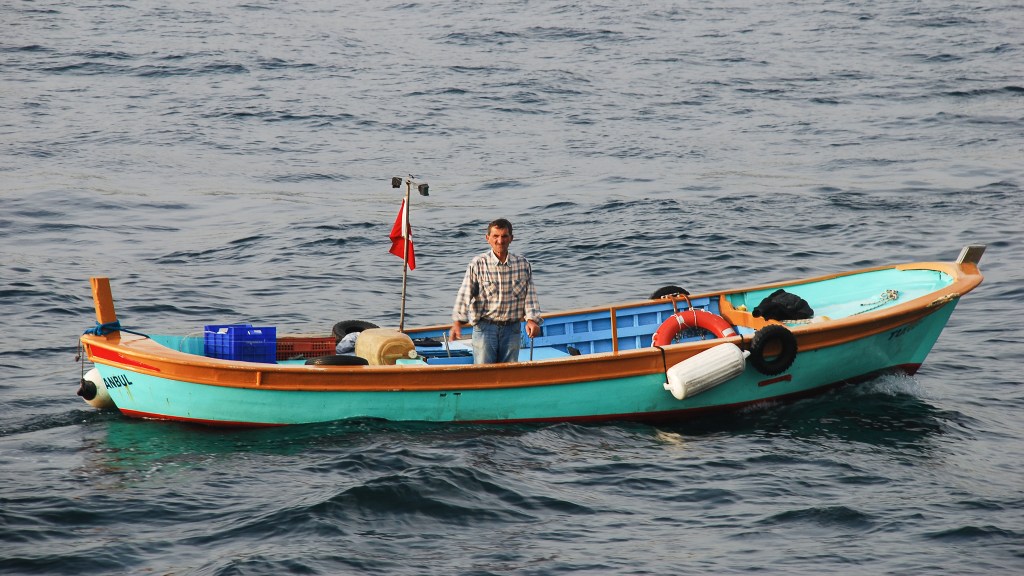
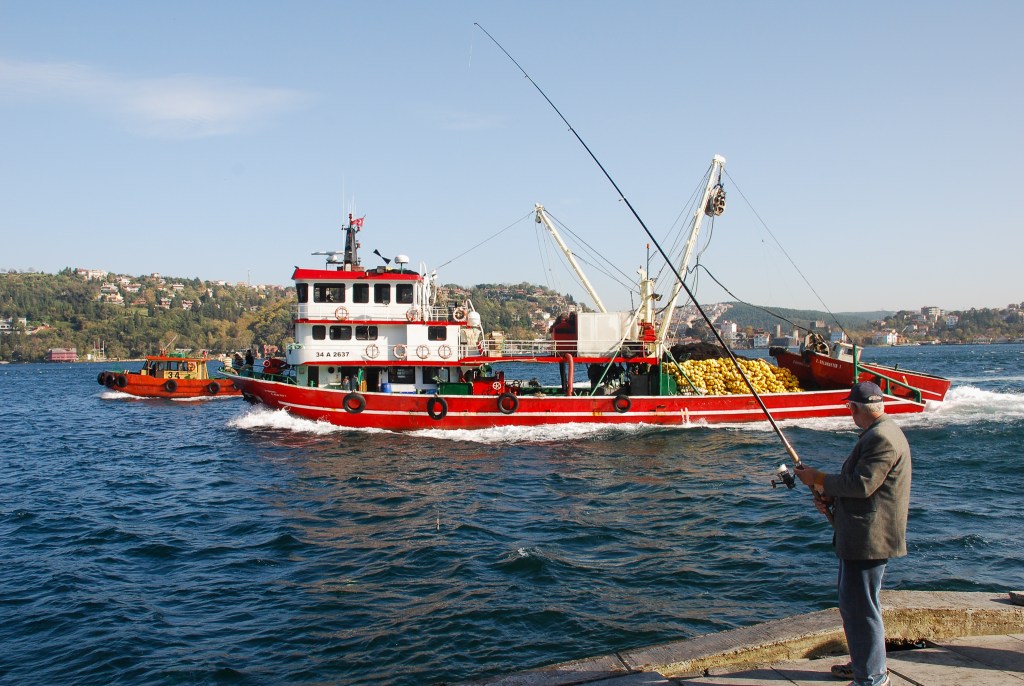
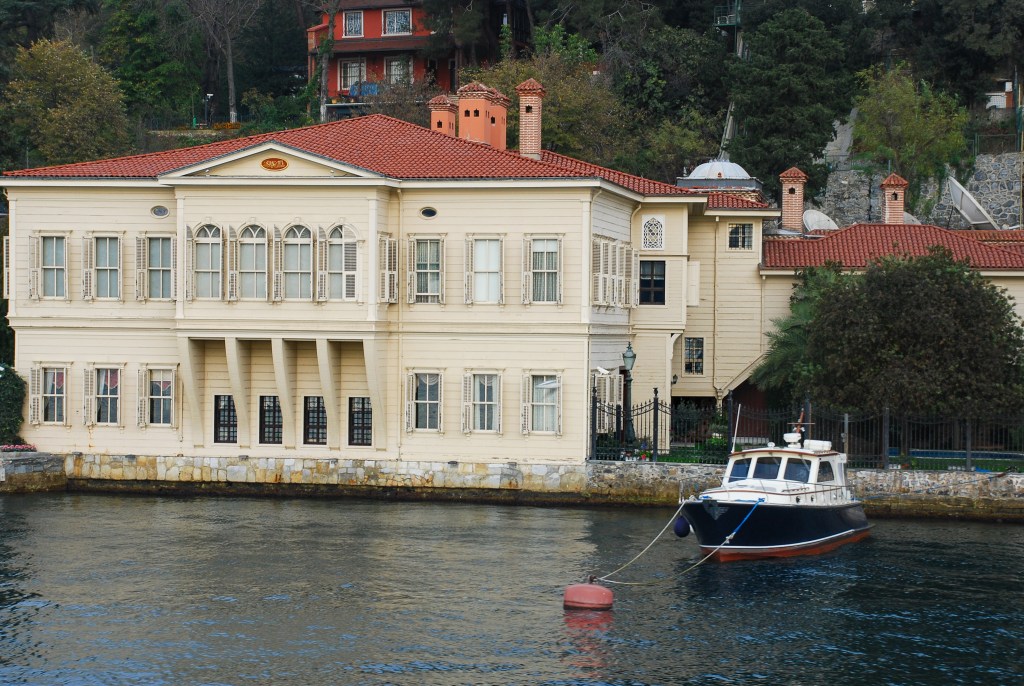
The picturesque Ortakoy Mosque glows in warm sunlight as it stands waterside on the Bosphorus. The Bridge behind it is the Bosphorus Bridge. It connects Europe with Asia.A quiet inlet off the Bosphorus fills with day boats and tour ferries. A lone fisherman idles along the Bosphorus in a colorful skiff. The Straits are working waters as well as a beautiful view.A fisherman casts from the seawall as working boat churns past. A portrait of power versus patience on the Bosphorus.A waterfront mansion sits right at the edge of the Bosphorus, its beautiful tender rides steady on the restless tide.Historic houses, sun-faded and salt-worn, are still standing along the Bosphorus. These old friends are currently under repair. There is something special about the quality of light in this image.A view of where the Bosphorus meets the Black Sea. We enjoy a lunch here of fresh sardines and salad greens.Site Icon
Check out the first post in this series from Istanbul
It began with a recurring dream. A small, vivid vignette that returned again and again.
I am startled awake by a haunting voice. A strange, melodic chanting in a language I don’t understand. I open my eyes and search the darkness. Where am I?
A hotel room: wood floors, four-poster bed. A dim glow seeps through gauzy curtains drawn across French doors. The chanting continues, muffled and distant, as if carried through stone.
I cross the room, open the doors, and step onto an iron balcony—into another century.
Predawn light hangs over the cobblestone streets below. A man pushes a cart piled with bread. Two figures in black drift silently along the stones. The chanting echoes through narrow canyons of block walls. The air is heavy with sea salt, damp and alive.
Again, where am I?
Then it clicks. The chanting is the Muslim call to prayer. The figures in black wear abaya and scarf. I’m in an ancient city near the sea.
Over the next few months, the same dream returns. I begin to wonder why. Is it a sign? A premonition? An invitation?
I chose to believe it is an invitation. And I accepted.
Istanbul
Istanbul is an international city with a population of nearly 16 million people, of which over 90% are Muslim. A large majority are Sunni. Istanbul straddles the Bosphorus where Europe looks across the water at Asia and Asia looks back. Istanbul is one of the rare cities that doesn’t belong to a single civilization as much as it belongs to a long history of many civilizations. Around 660 BC, the Greeks named it, Byzantium. In 330 CE, The Romans changed it to, Constantinople. In 1453, the Ottoman Empire renamed it, Istanbul.
My home in Istanbul is a privately owned guesthouse in Sultanahmet. Just like in the recurring dream, it has wood floors, a four-poster bed, and tall windows overlooking a cobblestone street. Unfortunately, there’s no balcony. But every morning, at the first hint of dawn, I wake to the Muslim call to prayer.
Sultanahmet is Istanbul’s most historic district, a place that distills centuries into a walkable neighborhood. Sit at an outdoor café and set your Turkish coffee on a table patterned with Byzantine mosaics. Look across the tree-lined plaza that once held the Roman Hippodrome, where chariots thundered in circles. Marvel at the Hagia Sophia—once a Christian cathedral—sharing the same open space with the Sultan Ahmed Mosque, known to the world as the Blue Mosque. Between sips, you’ve taken in sixteen hundred years of history.
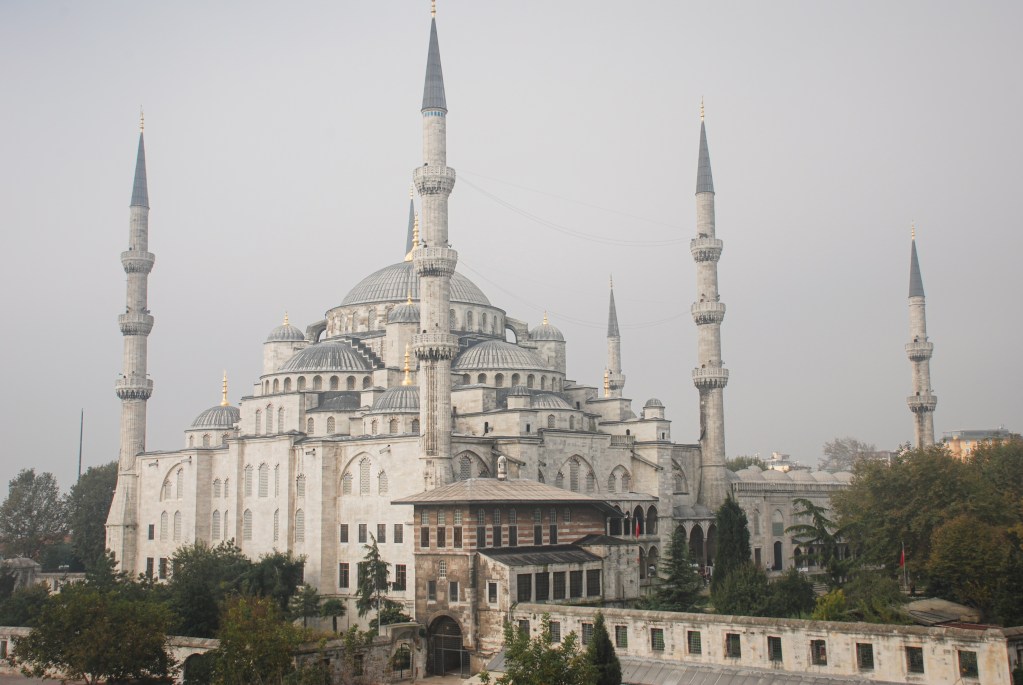
In this post, I want to narrow the focus to the Blue Mosque and the challenge of doing justice to it in a single photograph.
The Blue Mosque
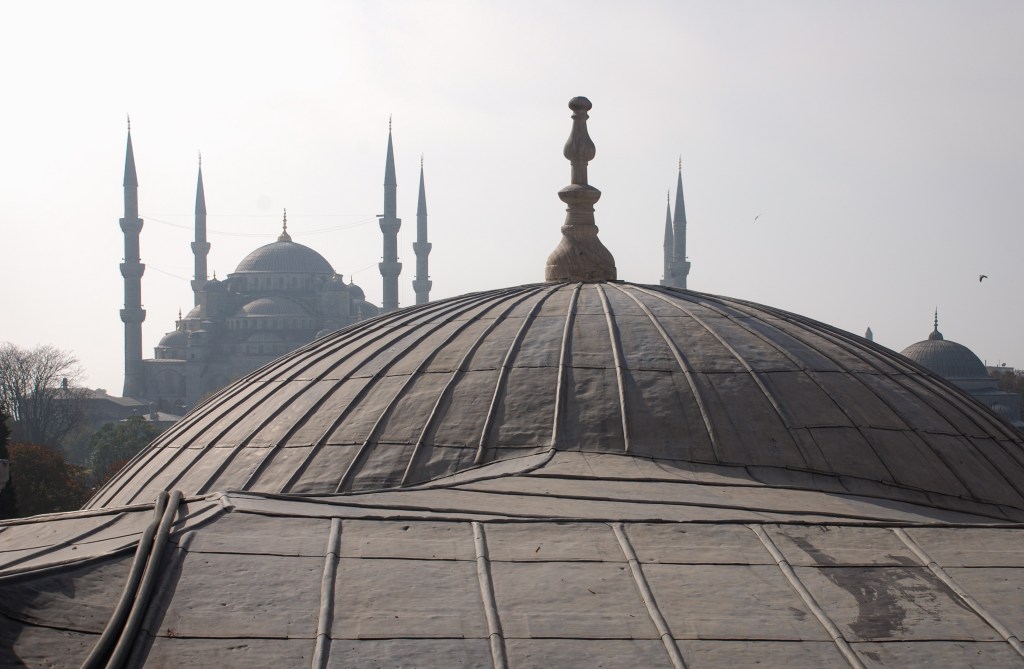
From a window in the Hagia Sophia, the domes and minarets of the Blue Mosque rise into the pale Istanbul sky. A shared presence that spans centuries.
The Blue Mosque isn’t a single building. It’s a small city of stone; a cascade of domes and half-domes rising into the sky. From ground level, no photograph can fully convey its presence. From here, you only catch fragments: a minaret slicing into the air, a dome hovering above a courtyard, a curve of leaded roof glowing bluish-gray in the morning light.
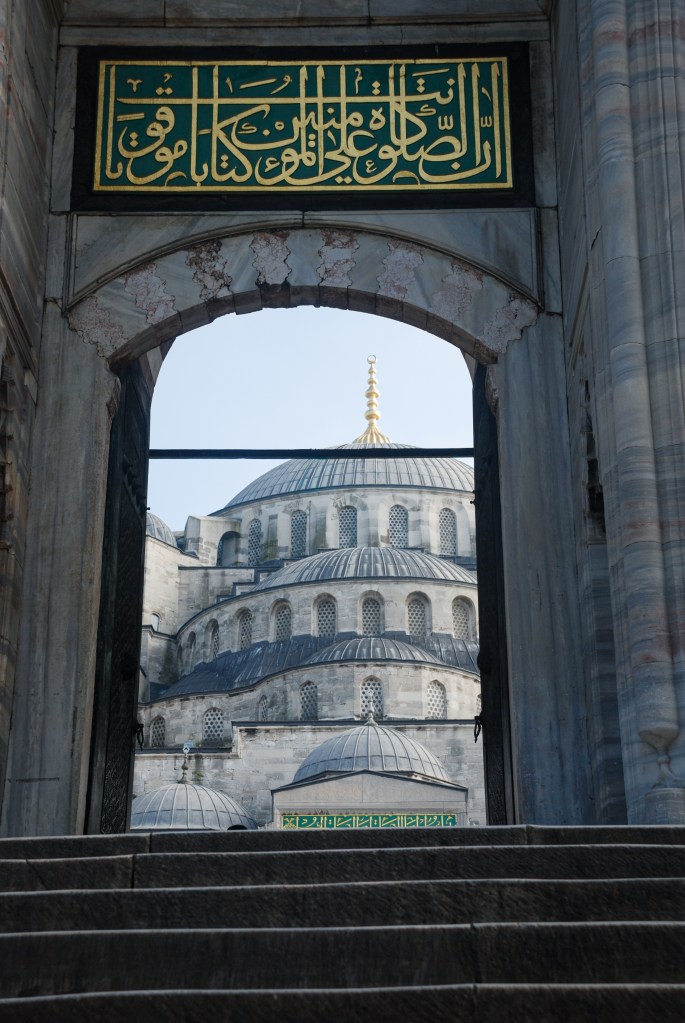
Through an arched front gate, the domes of the Blue Mosque rise in layered silence, where calligraphy, stone, and sky meet.
The Courtyard
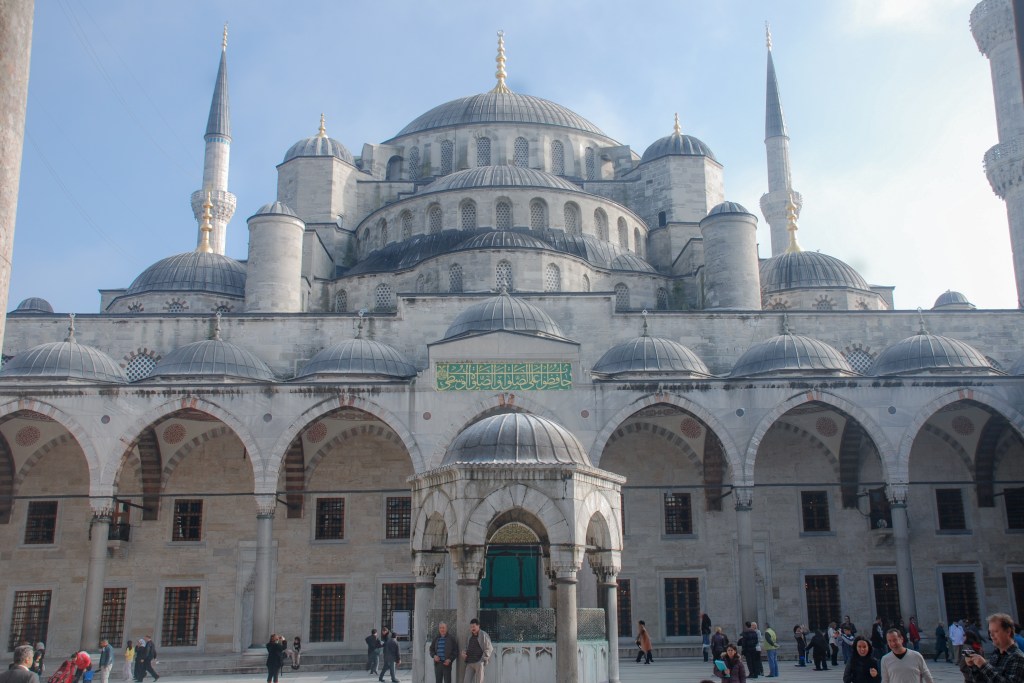
Beneath a cascade of domes, the Blue Mosque opens to the city, holding both the sacred and the everyday in the same wide embrace.
Entering through the front gate feels like crossing into another world. The courtyard welcomes you with calm, a pause from the noise of Istanbul. Both expansive and intimate, it was designed as a place of prayer and passage.
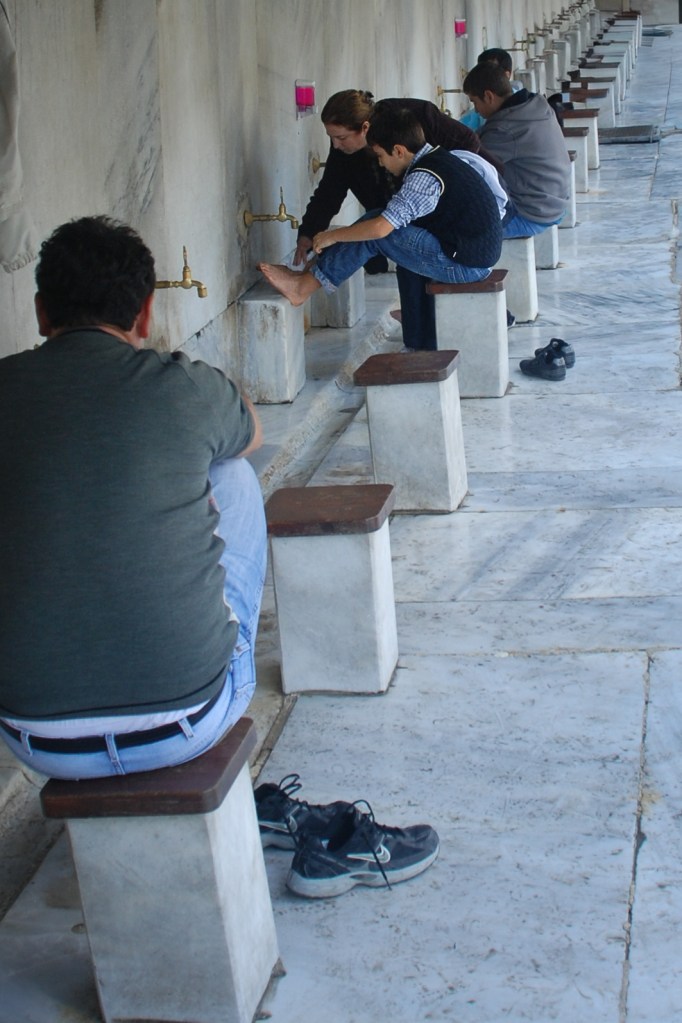
The mosque is so immense that only a portion of the façade fits in this frame. Still, I managed to catch something even rarer—a small moment between a mother and her son at the fountain.
At the ablution fountain, a mother washes her son’s feet in preparation for prayer. And for a moment the world stops spinning and nothing else matters. After 16 years, this image still moves me to tears.
Inside the Blue Mosque
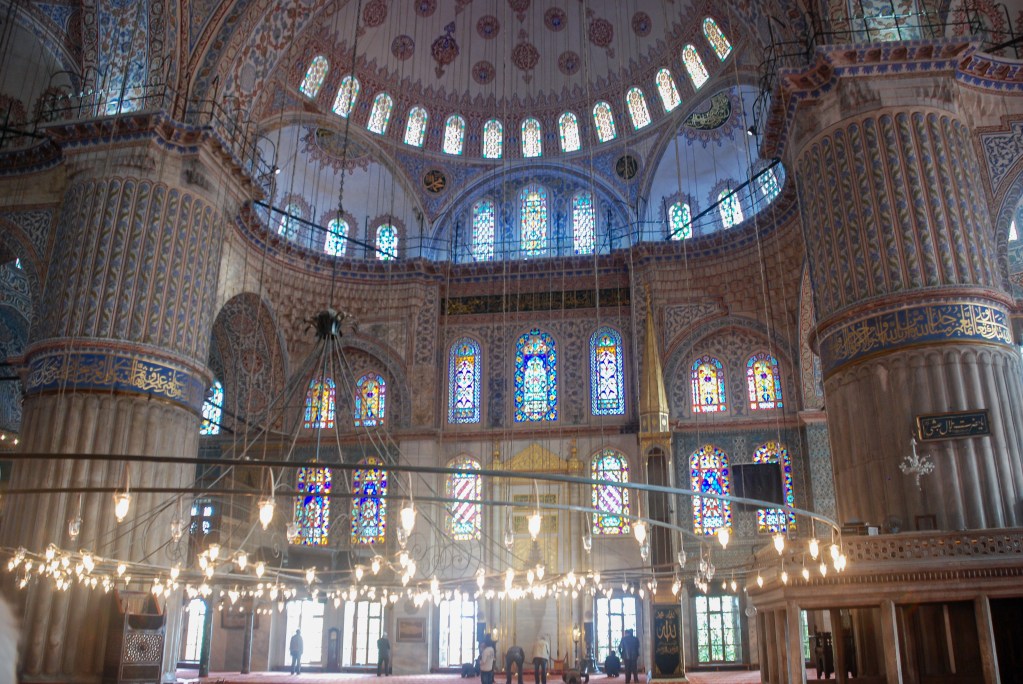
Inside the Blue Mosque, light pours through stained glass and gently illuminates domes, columns, and prayer rugs.
The central dome of the Blue Mosque rises 141 feet above the prayer hall floor. To understand the scale, notice the people standing underneath the circle of lights. These lights hover dozens of feet above the floor. About the same height as a second story window.
Imagine what it’s like standing in this enormous vertical space. Once again, the area is so vast it resists being contained within a single photograph.
The Last Day
It’s my last day in Istanbul, and all I can think about is getting the Blue Mosque into a single frame.
I wake early and circle the structure inside its gravitational pull. The walk through Sultanahmet is beautiful. The streets are quiet, and the light is soft. Still, in my viewfinder, the mosque is only pieces and fragments. A minaret here. A dome there. Never the whole.
Frustrated, I sit beside a marble fountain. It’s so early even the ubiquitous pigeons haven’t arrived. I lean back against the cool stone and close my eyes. My thoughts drift to one important question: where will I get my last Turkish coffee of this trip?
I open my eyes, take a slow breath—and see it.
A building about ten stories tall, topped with a terrace shaded by green canopies. The kind you’d find at a rooftop restaurant. And it sits diagonally across from the Blue Mosque. My mind’s eye draws a straight line from that terrace to the mosque—an unobstructed view.
How do I get up there?
I walk to the front entrance. Through the glass I see a front desk and someone standing behind it. What do I have to lose?
Inside the Building
I push through the door, camera hanging from my neck.
“Can I help you?” he asks immediately.
“On my way to the terrace,” I say, with a hint of urgency.
“The restaurant isn’t open.”
(Yes. I guessed right.)
“I’m here to take photos while it’s closed,” I reply without missing a beat, one hand on the camera.
He stares. Then looks me up and down.
One second. Two seconds. Three.
Without breaking eye contact, he jerks his head toward what I hope is the elevator. I nod and move quickly, resisting the urge to look back.
The elevator doors open directly across from the kitchen.
Two guys in white aprons look up at me like I’m a raccoon that learned to use buttons.
“Can I help you?”
The place is empty. The only lights on are in the kitchen. Beyond them, the terrace glows with soft morning light.
I glance toward the terrace and then back to them. “Actually… I was hoping you’d let me take just one photo from your terrace of the Blue Mosque. One photo and I’ll be gone. That’s it.”
Kitchen staff are impossible to bluff. Their instincts are razor sharp, honed on tourists, critics, charmers, and every variety of human behavior.
On this top floor, honesty is my only chance.
He looks at the terrace. I follow his eyes. He looks at my camera. I look at him.
“Sure,” he says. “Go ahead.”
And he turns back to the kitchen, his mind already on something else.
The Shot
Outside on the terrace, I walk slowly toward the edge. With each deliberate step, the Blue Mosque reveals more of itself; domes stacking on domes, minarets rising into the sky.
The sunlight is veiled by a thin layer of cloud. A soft breeze carries the faint scent of roasted nuts and the sea. Below, a barely audible hum rises from the cobblestones as Istanbul wakes.
I lift the camera and bring my eye to the viewfinder.
There it is, filling the frame in full grandeur.
The Blue Mosque of Istanbul.
It remains one of my favorite travel photos of all time.
In a blush of soft morning light, the Blue Mosque stands in layered stillness, holding centuries of prayer within its stone and stained glass magnificence.
From domes and stained glass,
prayers ascend to the heavens.
There shines one light for all.
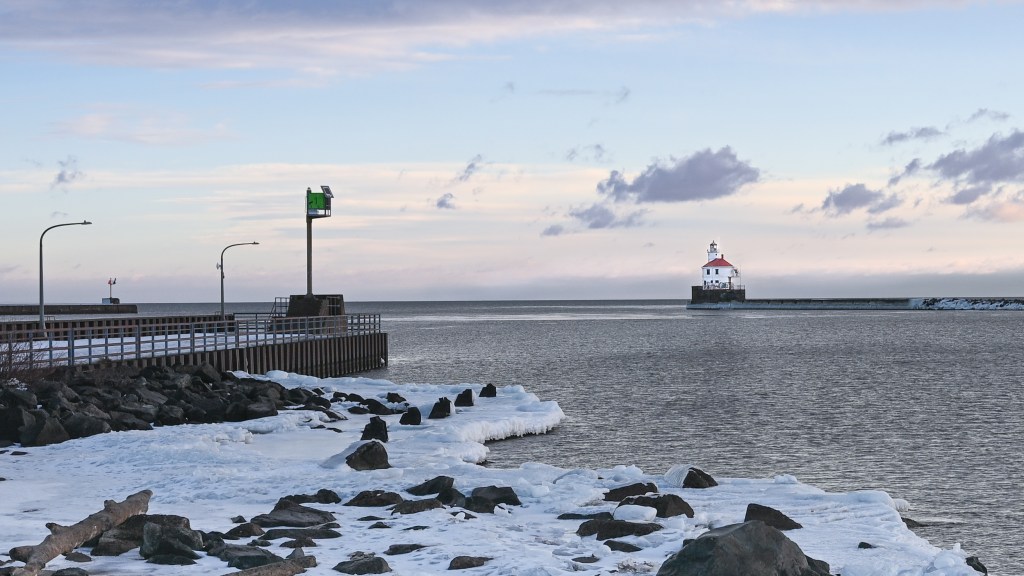
On a January morning, Jennifer and I wake up early and hurry to the tip of Wisconsin Point – a three mile long natural sand spit reaching out into Lake Superior and separating this great lake from the Duluth-Superior harbor. Wisconsin Point, along with its twin, Minnesota Point, make up one of the longest freshwater sandbars in the world.
The Wisconsin Point Lighthouse stands at the threshold of Superior Harbor, its red roof a beacon between cold winter sky and concrete. The breakwater draws a quiet boundary between Lake Superior and a working harbor that’s closing in with ice.
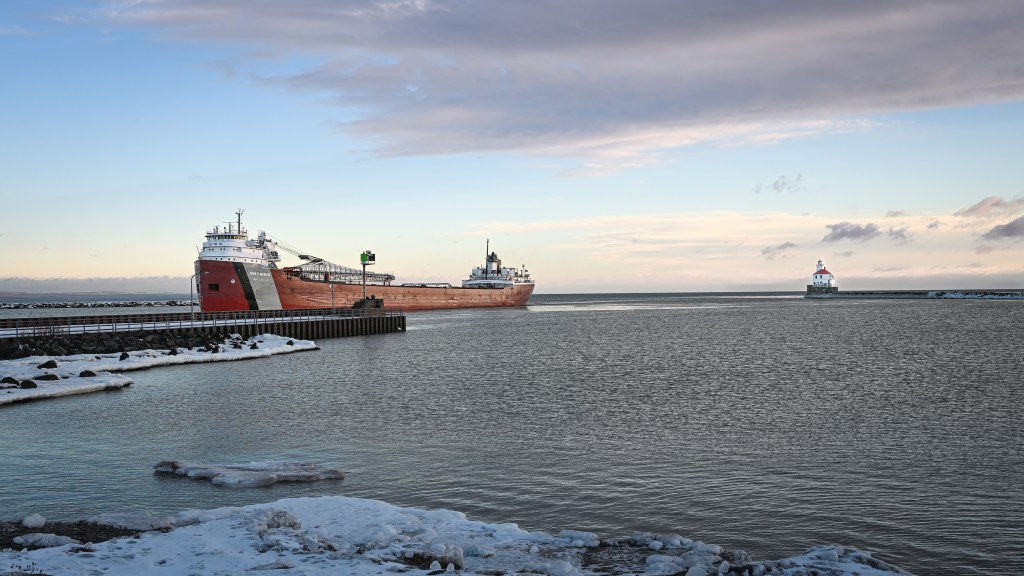
However, geography is not our focus this morning. Instead, we’re here to meet the Great Lakes Freighter, John Munson, as it comes into port for a the winter layup.
The freighter, John Munson, enters the Duluth-Superior Harbor for winter layup, her long hull easing past Wisconsin Point through the cold, gray water of Lake Superior. Built for motion and brute force, the ship slows now to an idle as it glides towards a long pause for ice.
Iron and diesel -
tools of a revolution,
give way to water
A red banner on the weather app declares, “Winter Storm Warning.” Outside, blowing snow confirms the alarming forecast. Five to nine inches of snow and wind gusts to 40mph are predicted.
Steam rises from the coffee maker, announcing its job is done. Camera and Lenses are packed; Coat, hat, gloves, boots, and thermos – check.
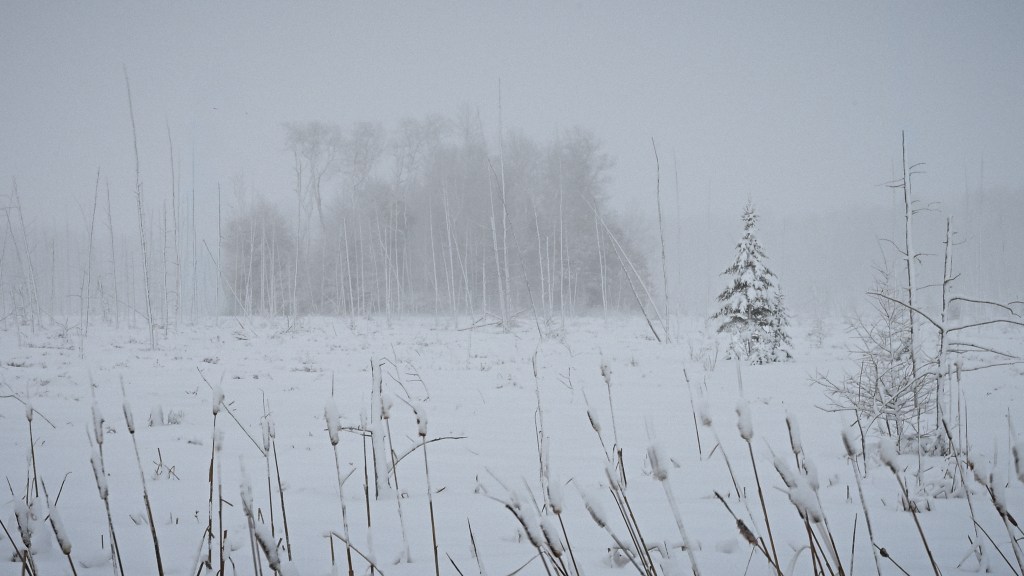
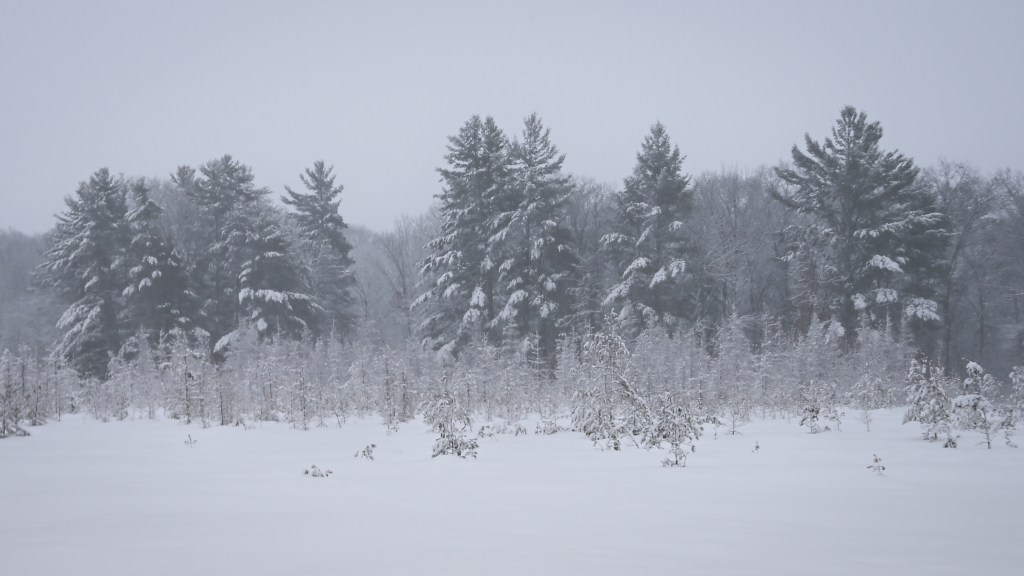
A December storm shrouds the bog in thick fog and snow.
“Travel will become difficult and dangerous as the snowstorm continues throughout the day,” the warning adds. “Unnecessary travel is not advised.”
White Pines stand like sentinels in the storm
I know the route. A drive past my favorite bogs. The same ones featured in previous posts – this time expressed in near-monochrome. The hue is black spruce. The value dilutes to a trace in shadows of drifting snow.
Tamarack and Black Spruce rise out of the snowy bog like skyscrapers on Manhattan Island.
A gentle descent into the Yellow River valley. Snow is piling up. There are no tire tracks on what used to be the road. Opening the truck door, snow rushes into the cab. I step out with my camera, it is almost to the top of my boots.
The Yellow River flows quietly under sheets of ice and blankets of snow.
The river ices over where it’s calm. Deepening snow captures sound and buries it until spring – only the north wind through pines and driven snow against my coat break the silence.
White Pines shoulder a weight of snow along the Yellow River.
I stop on a bridge near a bend in the river. White Pines full of snow bow to the river – Its dark iris reflecting the steel-gray sky of a snowstorm.
Color disappeared.
Flew south with migrating birds.
Minimal palette.
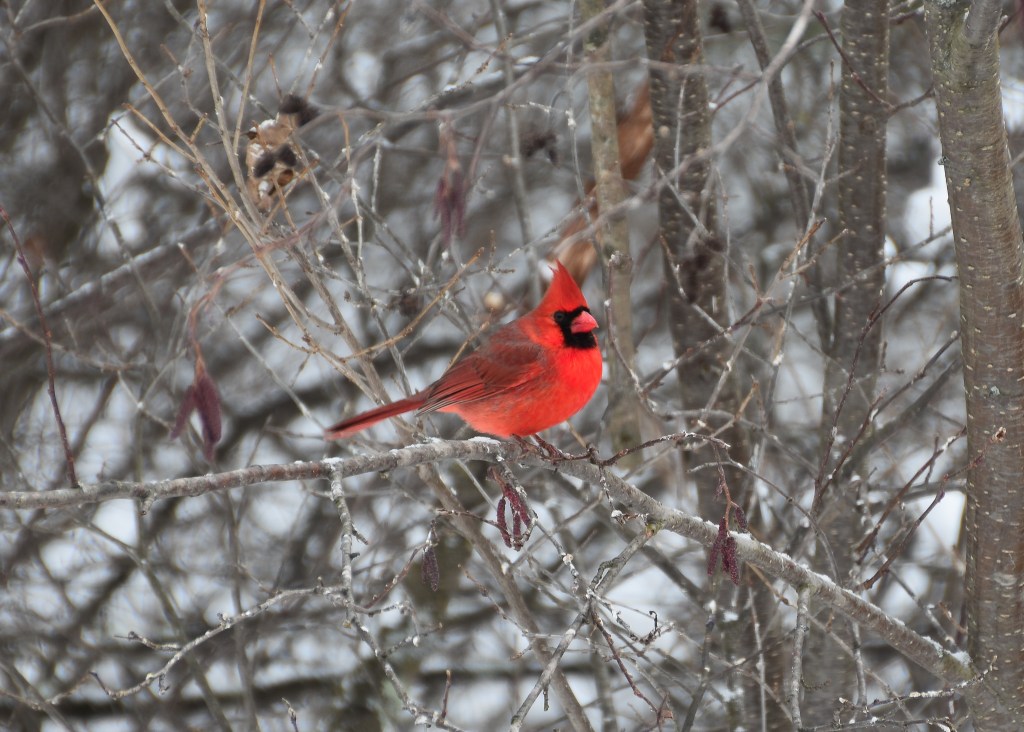
The Fred A. Busse was a City of Chicago Fireboat placed into service May 4, 1937. At the time, it was the largest diesel powered fireboat in the world. She retired from the Fire Department in 1981 and is now located at the Door County Maritime Museum in Sturgeon Bay, Wisconsin on the scenic Door Peninsula. The historic, and iconic, iron bridge is in the background.A male Cardinal in the Wisconsin winterAt the edge of water and ice, the Wisconsin Point Light keeps a quiet watch over Lake Superior in winter. It has guided ships since 1913 through the narrow passage between the greatest of lakes and busy ports of Duluth and Superior.
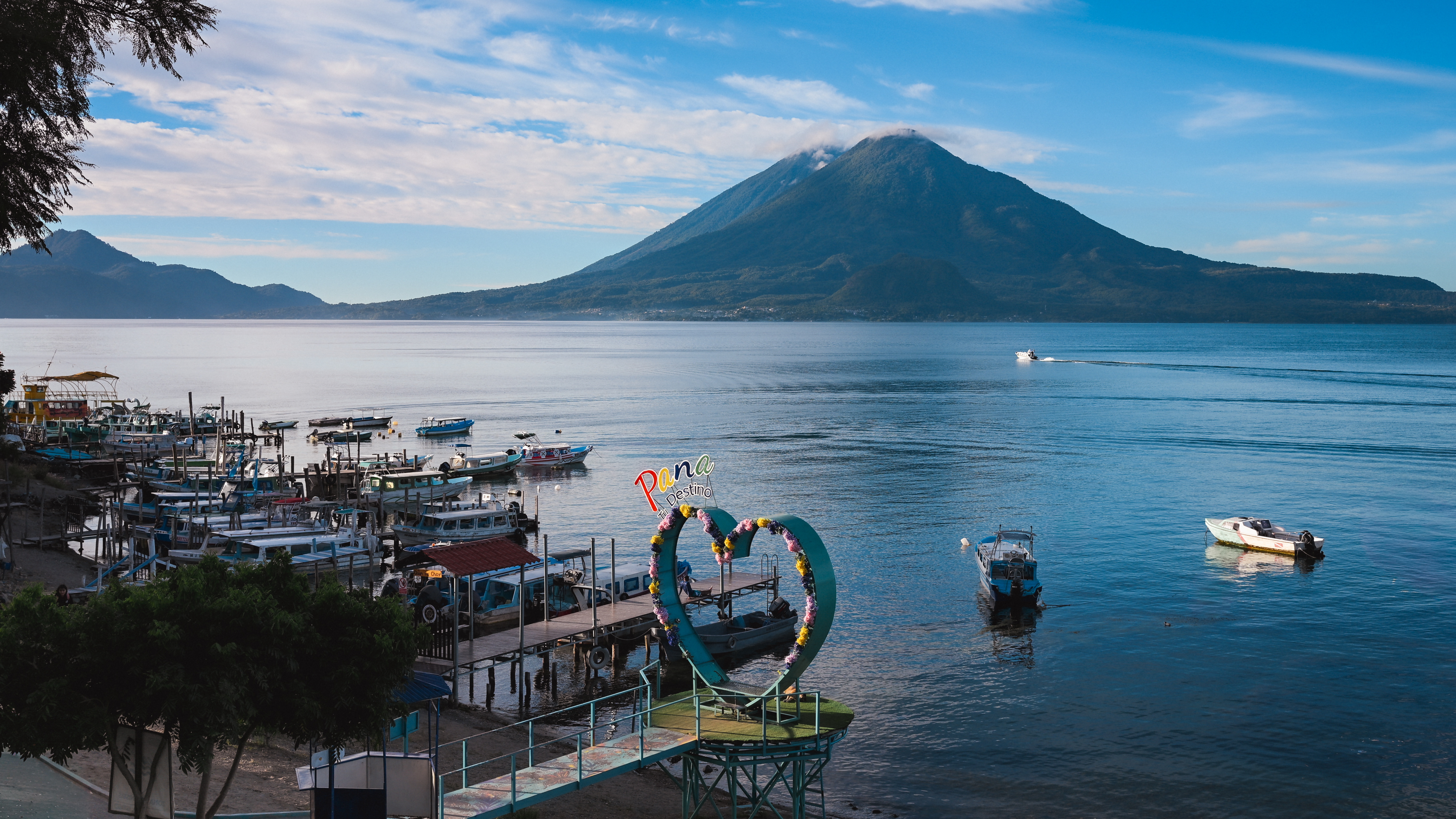
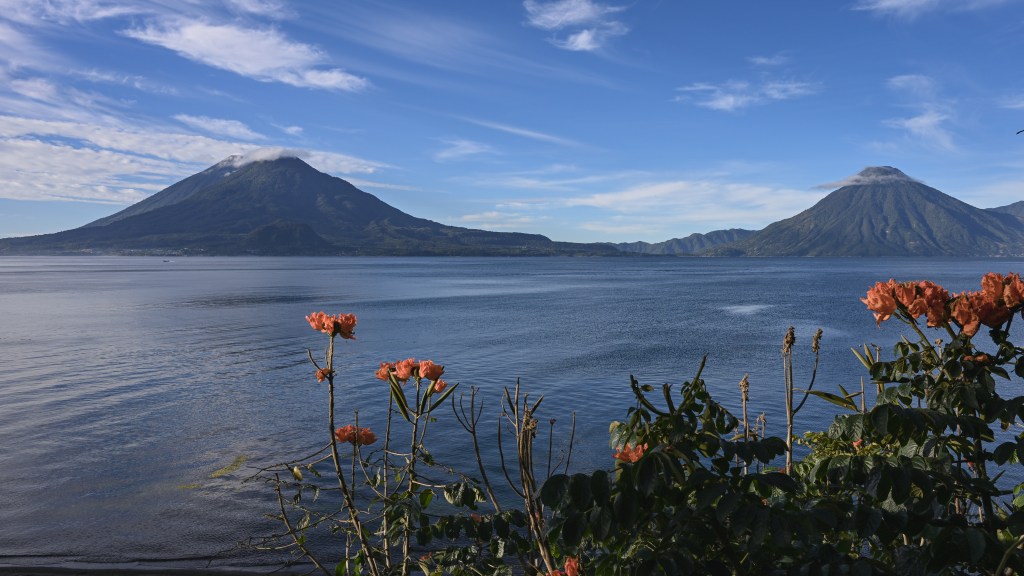
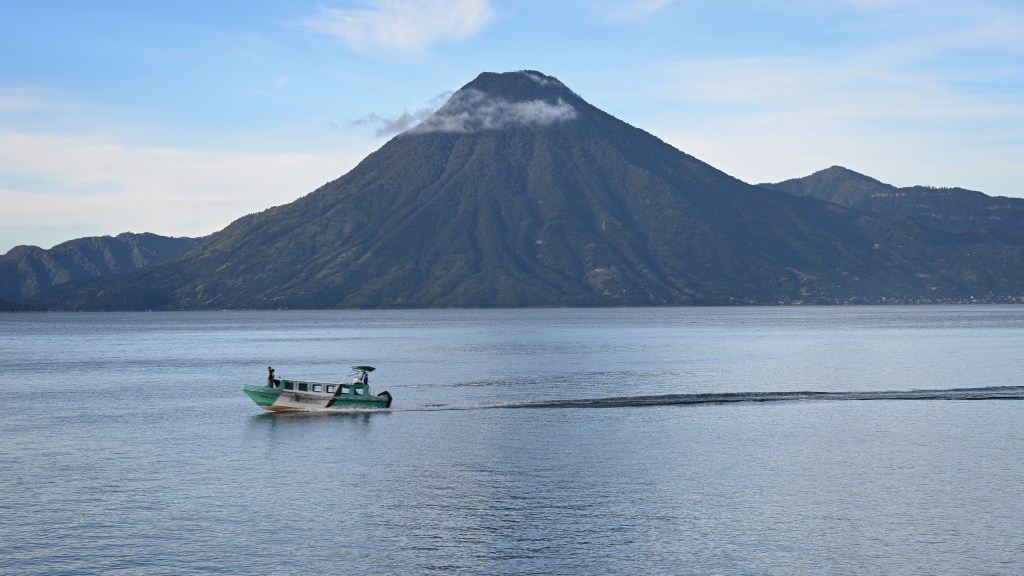
Lake Atitlán lies cradled in the Guatemalan highlands like a mirror held up to the sky. Clouds drift over its surface and float on the surrounding volcanoes. Three cones: San Pedro, Tolimán, and Atitlán, rise steeply from the water. Their forested slopes are etched by the ages and support a scattering of villages. The lake itself is an ancient super-volcanic caldera that filled with water over time. Even now there is a palpable sense of stillness here, as if the land is quietly aware of its eruptive creation.
Volcanoes Atitlán and San Pedro rise above the picturesque lake
Getting around the lake
For the most part, life on the lake moves by boat. Long, narrow launches awaken with the sun. Their wakes drawing temporary lines across an otherwise unbroken calm. These boats connect lakeshore villages like Panajachel, San Juan La Laguna, and Santiago Atitlán. Each hillside town has its own rhythm, colors, and traditions.
Launches at their docks on a beautiful morning. Volcán San Pedro shadows the village of San Juan La Lagunain the distance.A colorful launch crosses in front of Volcán San Pedro
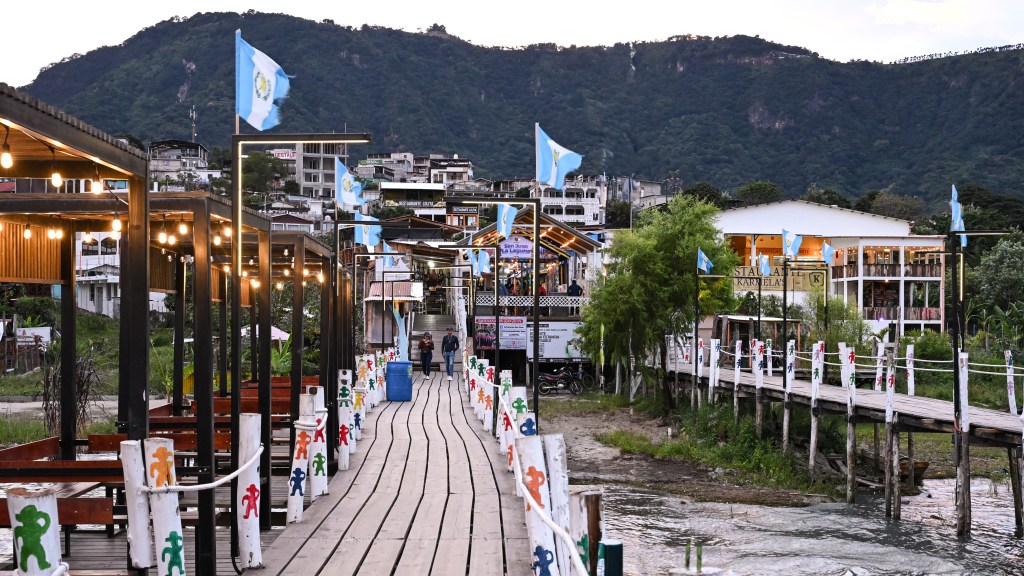
San Juan La Laguna
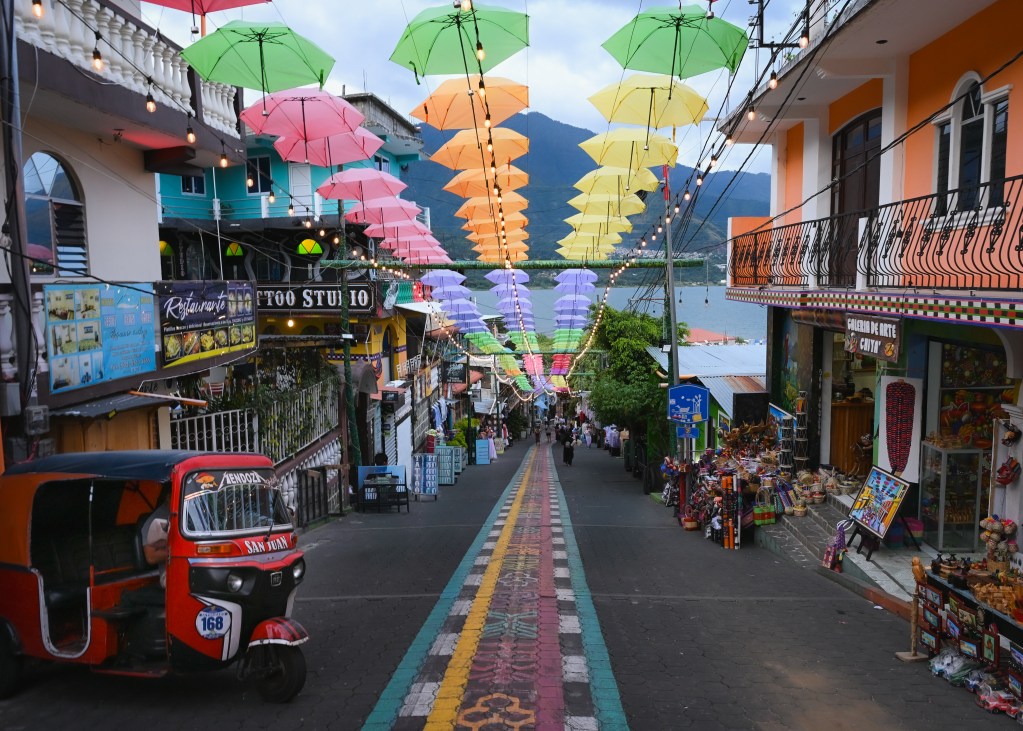
At San Juan La Laguna, color becomes part of the landscape, and the attraction. Hanging umbrellas, artwork, and embroidered fabrics echo the colorfulness of the locals themselves. Markets, murals, and quiet rituals all speak to a community deeply rooted in Mayan culture.
The boardwalk leading to colorful San Juan La Laguna.Colorful umbrellas cover the painted pavement along the main shopping street
The magic of Lake Atitlán
Lake Atitlán had been on my travel list for years – ever since reading articles and viewing images in various travel magazines. There’s something special about this place. Hidden below wild hills and majestic volcanoes, Atitlán has a quiet, mystical vibe. The history of this ancient crater drifts across the water like an evening mist. It encourages silent wonder. It asks us to slow down, stand on the end of a pier, and lose ourselves in a sunset that transcends the elements.
An amazing sunset over Lake Atitlán
I invite you to read this related post from a previous trip to Guatemala.
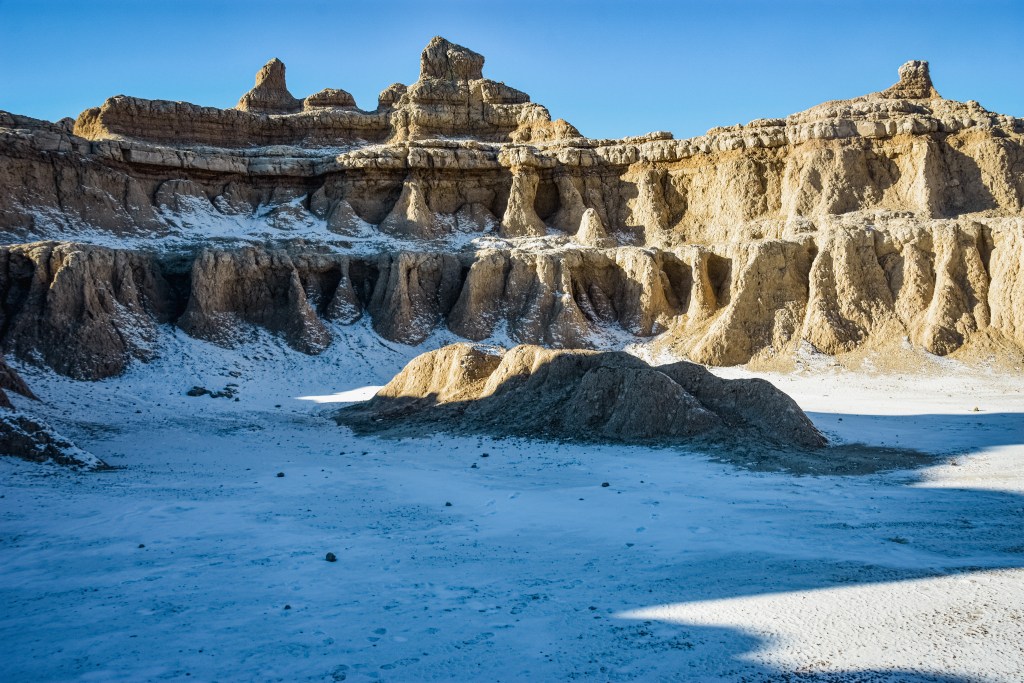
The geology of the Badlands isn’t a story of dramatic uplift like its neighbor to the west – the Black Hills. Instead, the Badlands is a story of what millions of years of erosion stripped away.
Over a period of 75 million years, ancient rivers, inland seas, and volcanic eruptions laid down ribbons of sediment. The sediment was compressed into very soft and fragile rock formations such as: mudstone, siltstone, shale, and ash.
The Black Hills uplift shifted water flow to the east into soft sedimentary layers. The erosion carved buttes, towers, ridges, and canyons into what is now known as the Badlands.
The Badlands of South Dakota – early winterA ribbon of prairie cuts toward the distant spires, revealing the intriguing boundary between grasslands and BadlandsColor-washed mounds of ancient volcanic ash rise from the grasslands. The yellows and purples indicate different minerals in the sedimentary layers.
The Process Continues
When we visit the Badlands today, we see a unique landscape still in the making. Erosion is Nature’s sculptor. Working through rain, wind, and the freeze-thaw cycle, it continues to pare back the cliffs at a rate that is one of the fastest in North America.
A quiet winter basin carved by centuries of erosion. The skeletal architecture of the Badlands is on display beneath a dusting of snow.The sculpting of the Badlands is still evident today. Recent rains run in rivulets through the soft sediments.
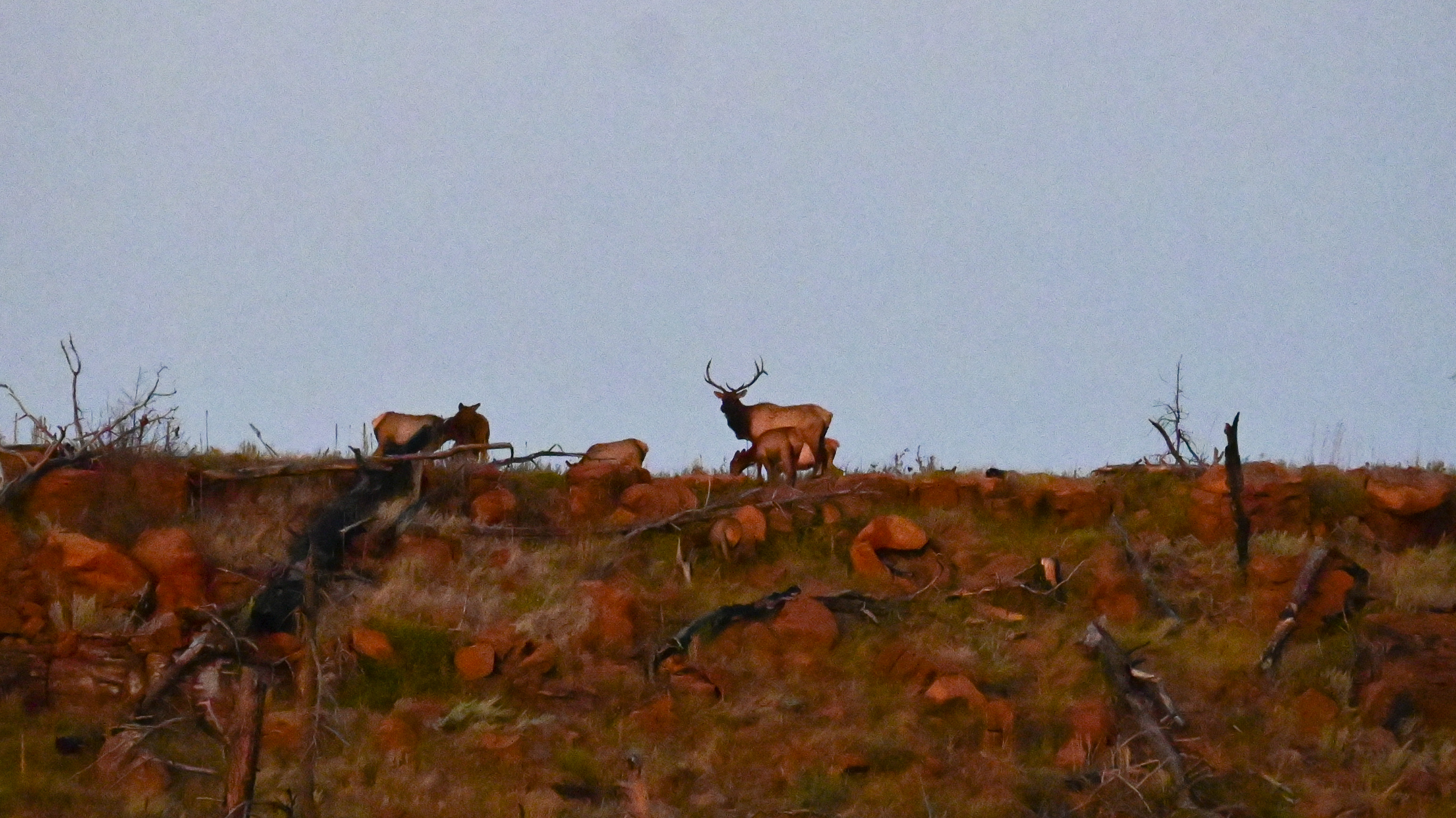
Custer State Park is home to one of the Black Hills’ most iconic wildlife species: the elk. They are often seen at first light or during the blue hour of deep evening. These magnificent animals, over 6,000 strong, roam the high ridges and open grasslands. They thrive in the shelter of Ponderosa Pines, rock outcrops, and prairie.
Statuesque on a ridgeline, Bull Elk of Custer State Park. * Image from a friend
In Search of Elk
With coffee and binoculars, morning and evening, we slowly drove the roads of Custer State park looking for the elusive elk. We saw a few cows along a tree-line, but at a great distance. An elk grazing in an open field, but it was so dark we couldn’t tell if it was a bull or cow.
We were down to our last evening and yet to experience the elk of Custer State Park in any meaningful way. The warm evening glow was already past its prime. No-one spoke of it, but hopes were fading with the last embers of the day.
Ghosts of Custer
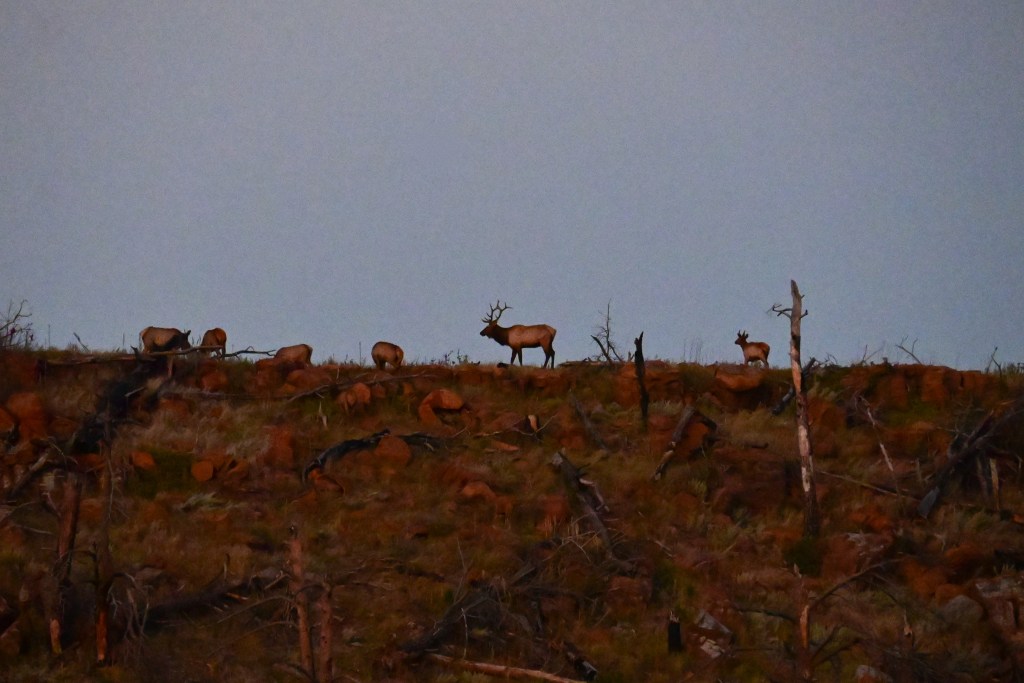
And then they were there. Ghosts floating on the ridgeline. A bull elk’s antlers lifting against the darkened big Dakota sky like a majestic crown worn by a king. The silhouette of cows rising from the rocks like living sculptures; the landscape coming alive.
Silhouette of a bull elk and its herd.
Dozens of elk were visible on the ridgeline. Others were moving like shadows down the burned-over slope, looking for water and fresh grass. Bull elk were bugling from every direction. How many elk were out of sight, just over the ridge?
Enjoy the experience with us. Click play! (and turn up your volume)
Bull Elk bugling as the herd descend from a ridgeline, looking for water. * Video from a friend.
A Toast to the Evening
It was an epic ending to a great week in Custer State Park. Watching elk move across the ridges, calm and unhurried, makes us feel like we’ve slipped into the deep, natural rhythm of the hills themselves. The elk embody the essence of this park: resilient, timeless, and rooted in a landscape that shapes everything around it.
Back in camp, I shared a glass of whiskey with friends in celebration of the elk experience. That night, our last night in Custer, I dreamed of bull elks standing stately on a ridge top.
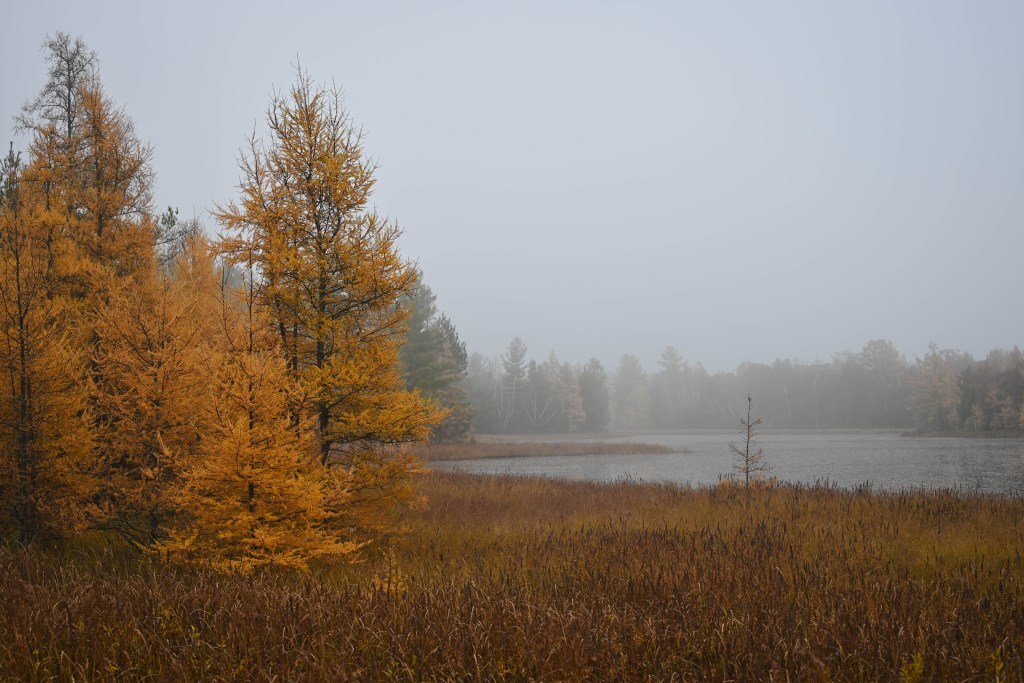
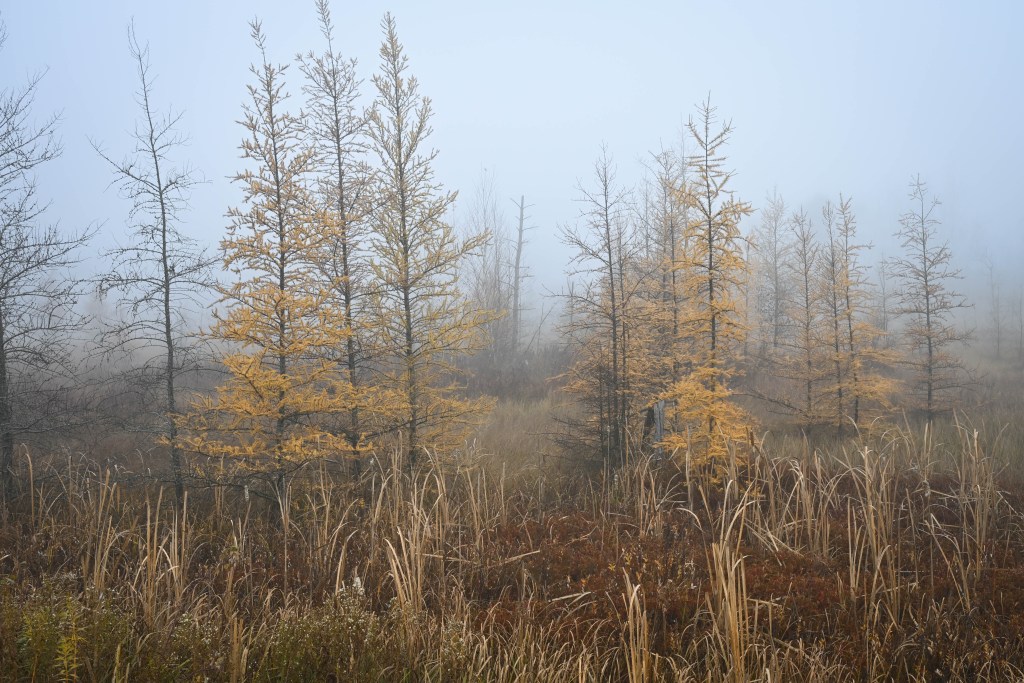
October in the northwoods of Wisconsin is magical. Tamarack trees change from green to a glowing, golden yellow, staying on branches long after birch and maple share their colors with the understory.
Golden tamaracks glow beside a marsh and small lake.Tamaracks in the wetlands
Days grow shorter, cold air masses migrating from the Canadian Shield push summer warmth to southern latitudes. Wetlands hold onto summer memories. Giving up little by little, creating dreamy, foggy mornings as they lose the battle.
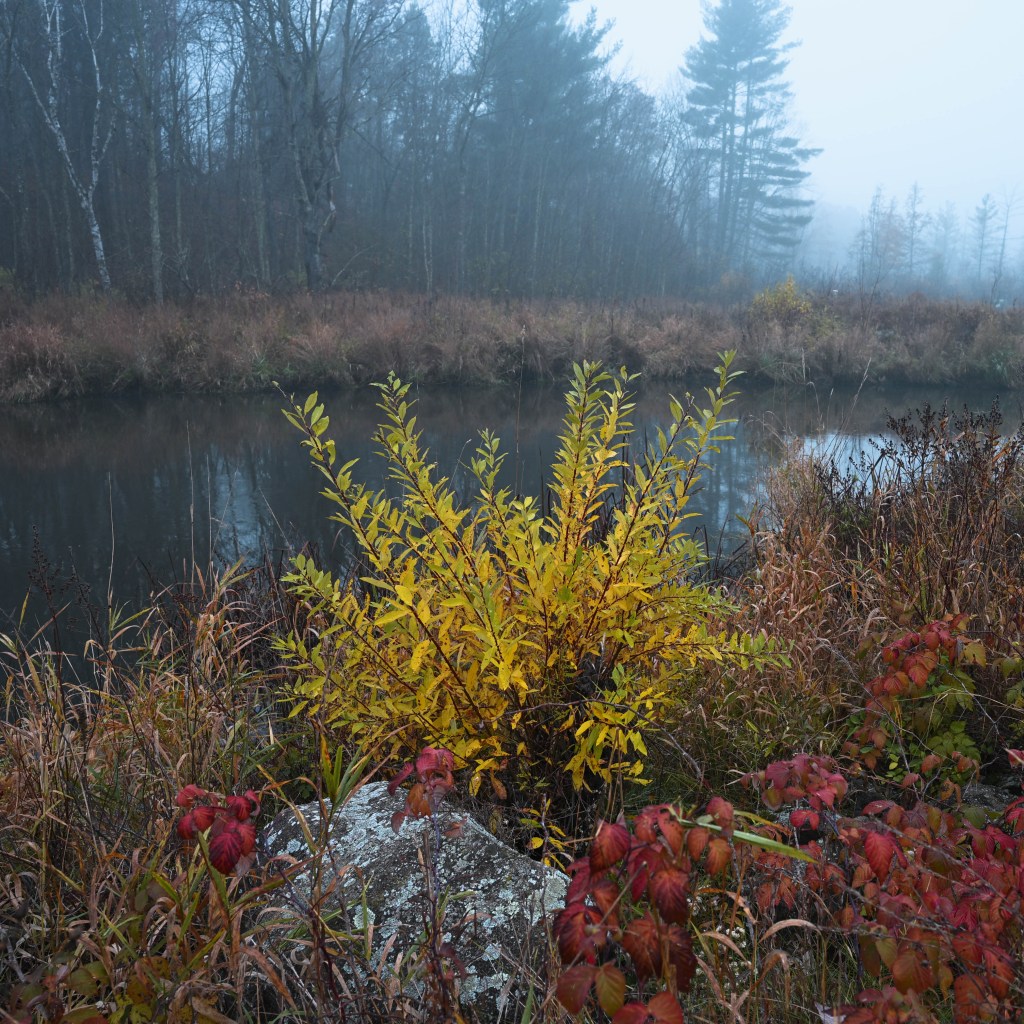
Yellow River in October fog
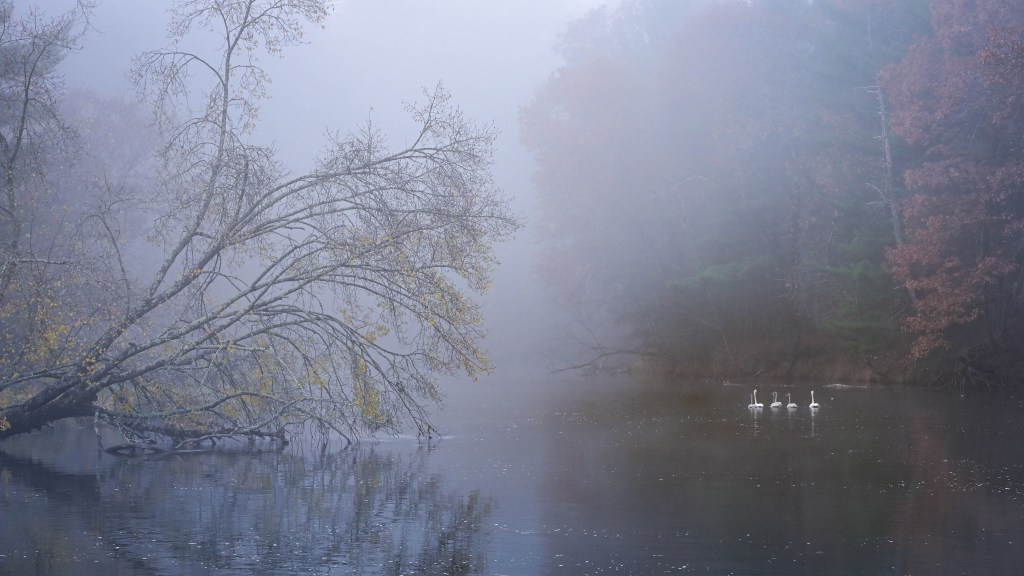
Migratory birds pass through our glacial region like ghosts in the woods and phantoms on the waters. We love their fleeting visits and miss them when they leave – knowing what is pushing them south.
Trumpeter Swans on the Clam River.
It’s a great time to be outdoors with a camera. Bugs are gone along with seasonal visitors. Bare trees provide a deeper view into forests. Colors are magical – saturated by damp morning air. The forest wears autumn’s scent. Earthy, a hint of vanilla or cinnamon. Harsh light of summer is gone. Magic hours of sunlight extend deep into the day.
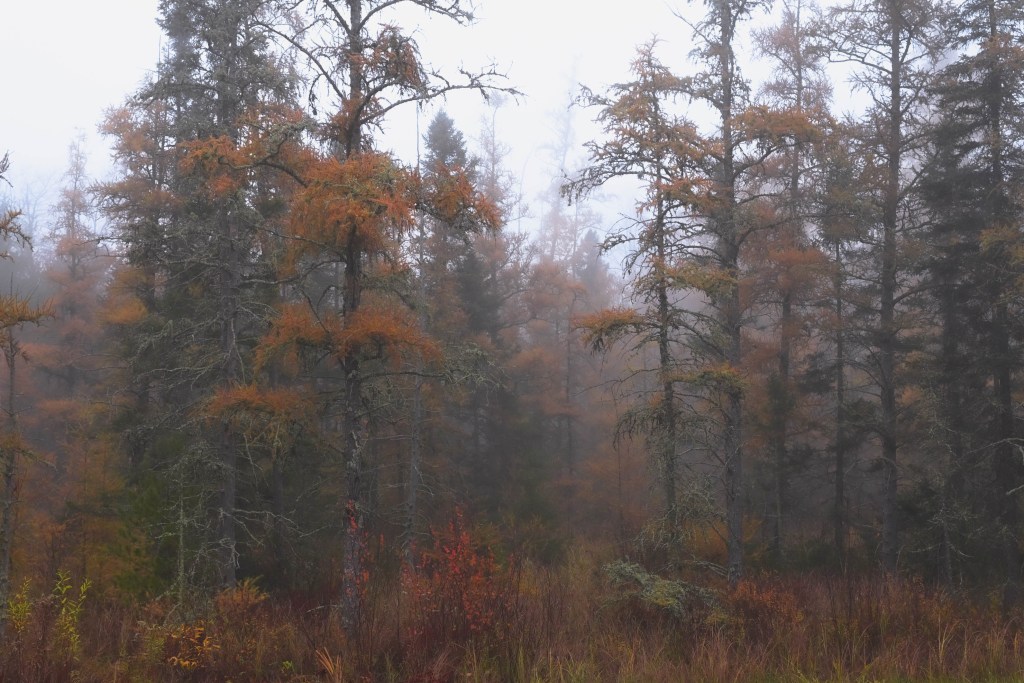
Painterly Tamaracks in a forest landscapeBrilliant fall colors along the Yellow River
“Morning brings back the heroic ages.” — Henry David Thoreau
And on foggy mornings, we step silently into them, and are so much the better for it.
To see more posts in the 5-Mile Radius Project, Click HERE.
Gary Donaldson
“Travel is about the gorgeous feeling of teetering in the unknown.”