
For as long as I can remember, I have been fascinated with the accomplishments and travels of Alexander Von Humboldt. Especially, his expedition across northern South America and Mexico between 1799 and 1804. I have the biography on Humboldt, The Invention of Nature, by Andrea Wulf. I also have volumes 1 and 2 of Humboldt’s notes and sketches titled, Cosmos: A Sketch of a Physical Description of the Universe. Much of this work comes from time spent on the Ecuadorian volcanoes of Chimborazo and Cotopaxi.
Humboldt’s influence reached far and wide. His writings inspired other generations of naturalists and explorers, including Charles Darwin and John Muir. Humboldt also inspired the famous American landscape painter, Frederic Edwin Church of the Hudson River School.
Frederic Church traveled to Ecuador in the 1850’s carrying Humboltd’s books and walking in the footsteps of the scientist and explorer he admired so much. Church’s awe-inspiring paintings of Cotopaxi and Chimborazo were more than landscape paintings, they were tributes to Humboldt’s vision of nature as both scientific and spiritual. Church was translating Humboldt’s written descriptions into iconic landscape paintings.
I have the book, written by Louis Legrand Noble, friend and travel companion of Frederic Church to South America, who assembled his journals and letters into the book titled, Frederic Church’s Travels in South America. I also have a framed print of Church’s painting of the Ecuadorian Volcano, Cayambe.
So you can imagine how excited I was to travel in the same footsteps of both Alexander Von Humboldt and Frederic Church!
Cotopaxi
Humboldt described it. Church painted it. And I took a trip to photograph it.

Cotopaxi, appears above the clouds like an island of ice in the Andean sky. For the first week of my trip, I was staying in a home overlooking the Cumbayá Valley outside Quito. The elevation was high enough to catch intimate glimpses of the volcano when the ocean of clouds would temporarily part.
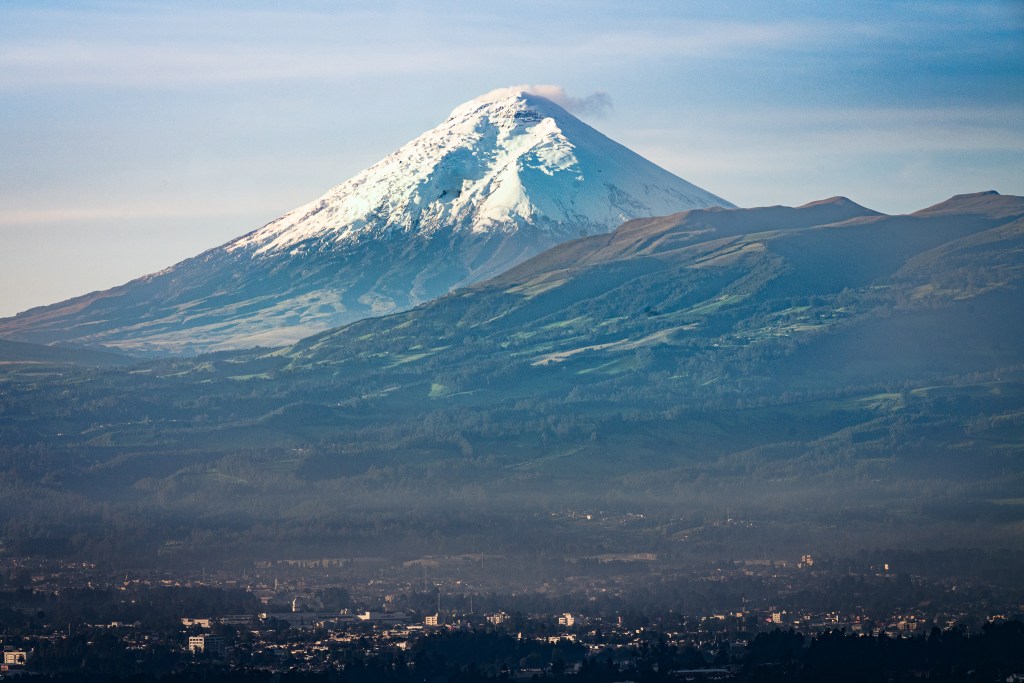
On a rare morning, Cotopaxi rises cleanly above the patchwork fields and the Cumbayá Valley of Quito.
The nearly perfect cone and crystal clear air (when the clouds aren’t present) explain why Cotopaxi is one of the most famous volcanoes in the world.
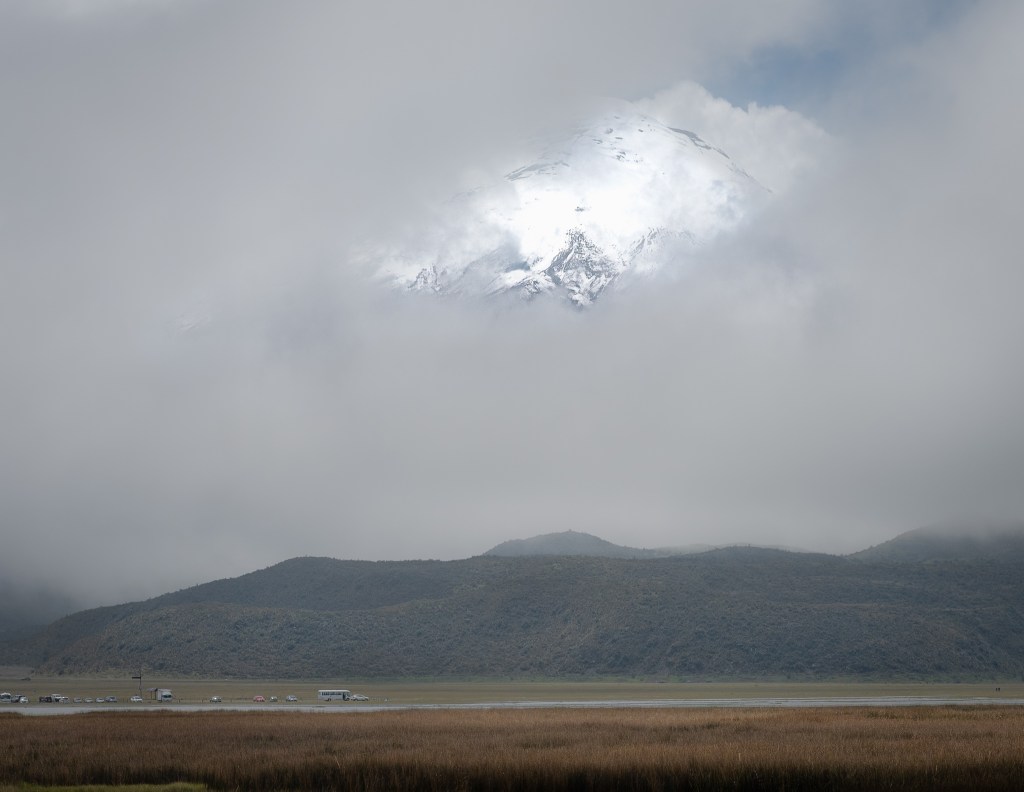
Locals say the young (geologically-speaking) Cotopaxi volcano is shy. She cloaks herself in clouds to hide her full splendor from those who come to peer at her.
Near the base in Cotopaxi National Park, the summit glows faintly through a veil of mist while the páramo grasslands stretch across the high volcanic plain.
The elevation here at Laguna Limpiopungo is 12,470ft! Cotopaxi peaks at 19,347ft. The vehicles, bottom-left, provide perspective.

Vegetation disappears somewhere around 14,000ft. Cotopaxi’s glaciers start around 16,000ft. I took this photo at approximately 15,500ft – nearly 3 miles above sea level. At this elevation, a deep inhalation provides only 60% of the oxygen I would receive at home in Wisconsin. And I was feeling it.
Standing beneath Cotopaxi, I suddenly felt as if I’d been here before. I first experienced this volcano in the pages of Wulf’s biography of Humboldt, then again through his notes and sketches in Cosmos. Later this place came into luminous focus as I fascinated over Frederic Edwin Church’s paintings of these majestic mountains. The print on my wall of Church’s Cayambe reminded me the Andes really did exist somewhere out there.
And now standing here with my camera, looking out over the expanse of the páramos, I imagine Humboldt with his barometer and Church with his sketchbook. Cotopaxi rises above me exactly as they must have seen it. Beautiful, mysterious, and timeless.




This blog is a place for stories and conversations. Add your voice below – I'd love to hear it.