
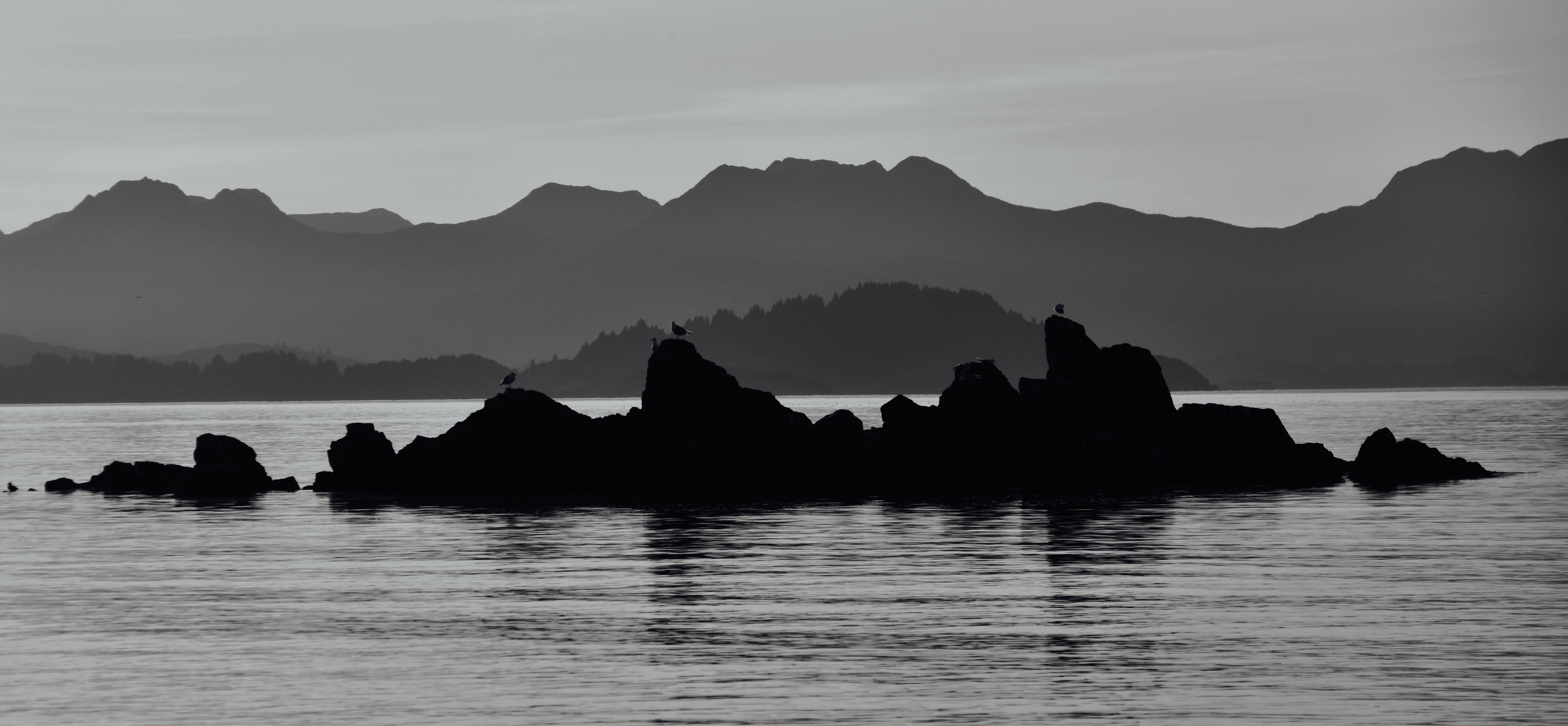
A few years ago, I went on a fly fishing trip to Kodiak Island, Alaska. We aimed to catch Coho and King Salmon on a fly. They were making their way up the freshwater streams to spawn. We had a great time catching many different species of fish and getting to know the local Kodiak Bears. I also enjoyed catching some beautiful landscape images along the way. Here is one example along with a discussion about composition and editing.
This image holds three natural elements: sky, rocks, and water. In this format, the elements are identified by their form and color value: lights, grays, and darks. We can see the elements in this image because natural light is present. It reflects to our retinas. The different values are a result of the physical nature of the elements: gas, liquid, and solid. Distance from the camera lens also plays a part. The farther the object is from the lens, the more atmosphere between them. This causes distant objects to be lighter in value. This is the basic natural science involved in this image.
The human contribution that creates art from the scene
First, it’s the placing of oneself in such a beautiful place on our planet. Second, is the willingness to hump camera gear along with all of the accouterments associated with fly fishing into a very remote area. Third, is noticing compositions like this when it presents itself. And fourth, is deciding how the composition will be presented to the viewers
Composition and Editing
The lightest part of the image is the beautiful horizontal line where the water meets the distant shore. I wanted to position that line near the horizontal center of the frame to achieve balance and interest.
The darkest darks and the lightest lights are where that horizontal line interacts with the rocks in the foreground. It’s powerful to be near the center of this image.
The vertical, dark reflections of the closest rocks are striking. They create a beautiful pattern with the horizontal streaks of waves in the foreground. This area is more interesting than the near monochromatic sky, so I gave this area more space in the image. It also helps lead the viewers’ eyes into the scene. The lost edges where the foreground rocks and waterline meet adds to the visual interest of the image.
The farthest hill carries some weight in the image. However, it does not carry as much weight as the formations in front of it. I cropped the image keeping all of this in mind to create an image that feels balanced.
The subtle cherries on top are the silhouettes of gulls perched on the three highest points of the foreground rocks.
What do you think about this image and its composition? Do you have the same fascination will gulls as I do? Share your opinion in the comment section below. Thanks!
Another Photo-worthy Landscape



This blog is a place for stories and conversations. Add your voice below – I'd love to hear it.